When describing Yerevan, they often name it a city of warm pink hues, and that’s no accident.
During the Soviet era, Armenia’s capital was enriched with dozens of impressive buildings crafted from local volcanic stone called tuff. The pink variety became so iconic that Yerevan earned the nickname “the Pink City.”
Many of these structures followed the traditional Soviet style, for example, the Railway Station, a classic example of Stalin-era architecture.
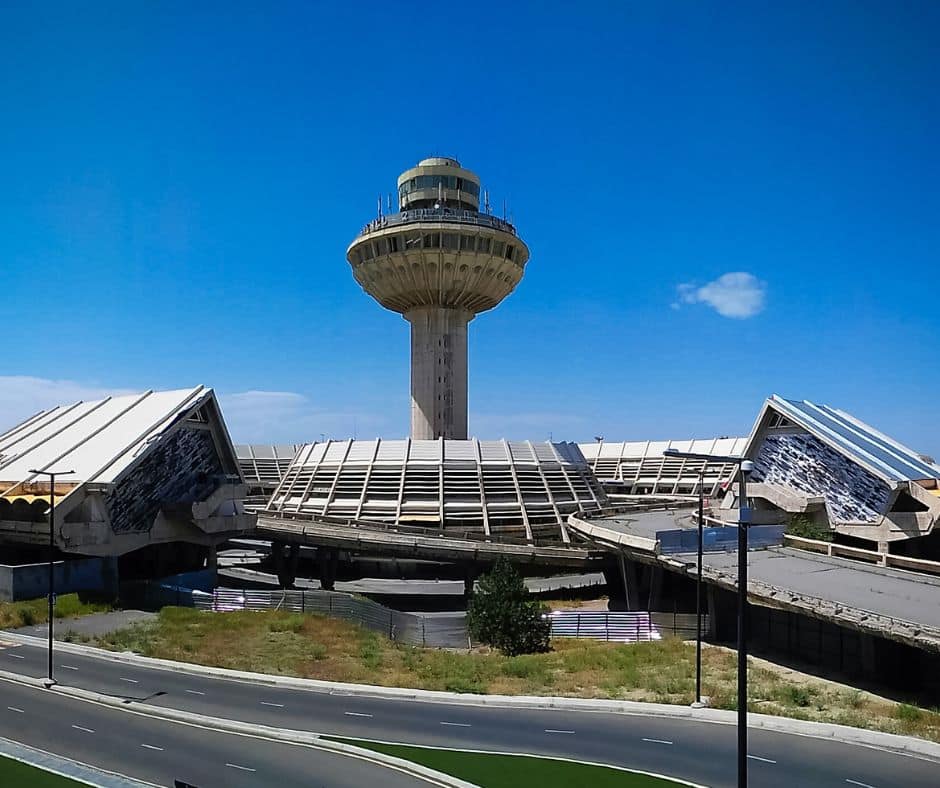
However, there are many buildings in Yerevan that have bold, experimental designs that captivate tourists. From the futuristic curves of Zvartnots Airport to the striking Rossiya Cinema, this is all about unusual buildings in Yerevan. This blog will list some unusual places worth visiting if you are in love with architecture.
Cascade Complex
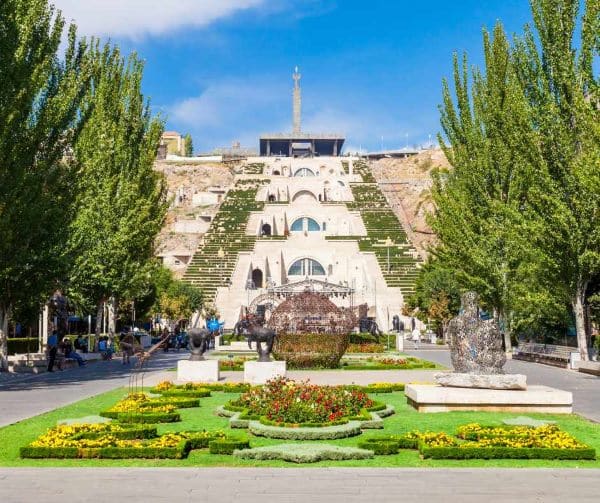
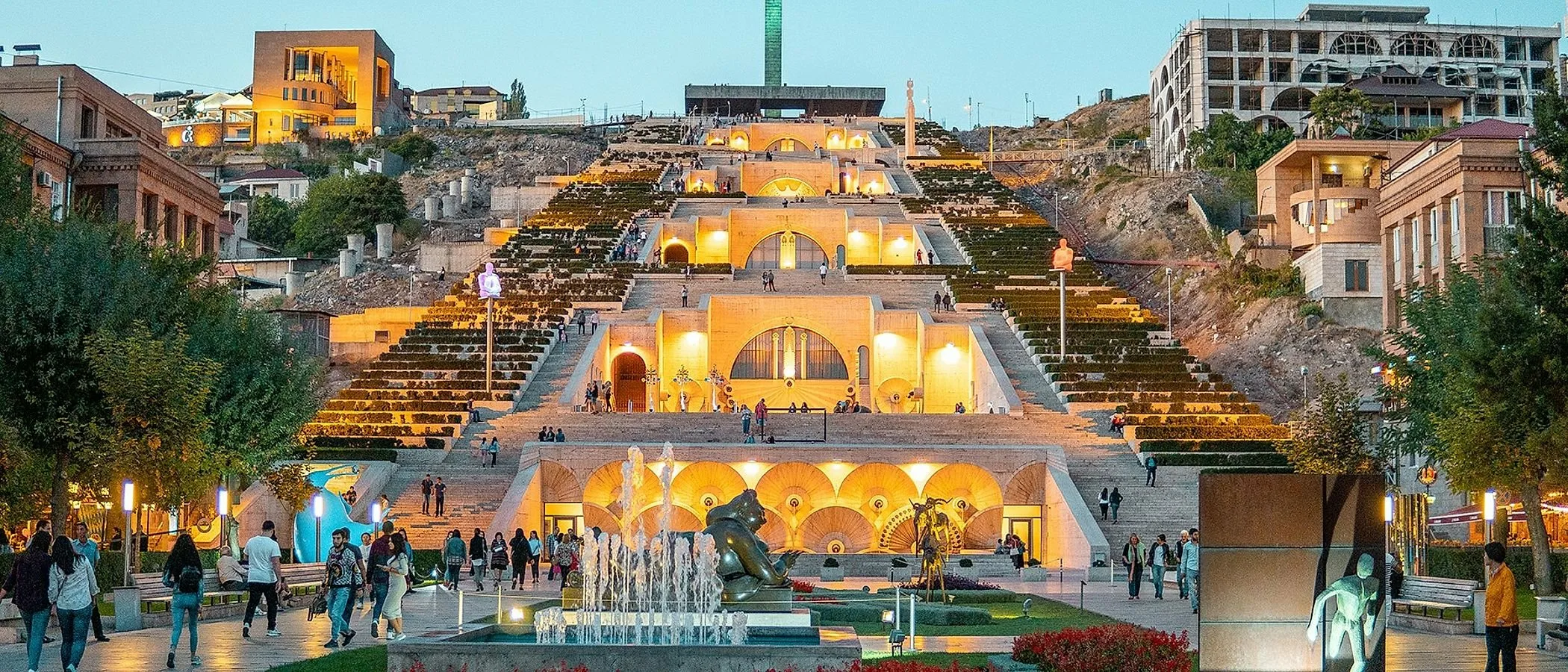
It might feel a bit cliché to kick off with the Cascade. However, is there anyone who could not notice it? This enormous staircase-meets-sculptural masterpiece dominates Yerevan and is a favorite tourist spot.
It’s also a wonderful example of a modernist monument. There are 572 steps stretching over 300 meters and climbing about 118 meters.
Conceived by Alexander Tamanyan in the 1920s as a linkage of gardens and waterfalls between the heart of the city and its heights, it finally took shape decades later. Yerevan’s chief architect Jim Torosyan returned to the idea of building the Cascade in the 1970s.
Cascading terraces stand out because of the sculptures and artistic touches. There are modern art installations and fountains. Now the Cascade hosts the Cafesjian Center for the Arts. There is also an indoor escalator to help you climb the stairs.
Old Building of Zvartnots Airport
This is one of the most popular spots among architecture lovers. Old Zvartnots Airport terminal is simply too weirdly striking to ignore. It was built in the late Soviet era, and its circular, cone-like structure echoes Armenia’s ancient Zvartnots temple.
In the past, this terminal was top-tier Soviet luxury. But today, as the new terminal was built, this once glamorous building is abandoned. The terminal is inactive, and now it is only a historic monument of a design era that has passed by.
The locals argue it’s one of Armenia’s most significant post‑Soviet monuments and even signed a petition requesting to stop the demolition of the old building.
Youth Metro Station
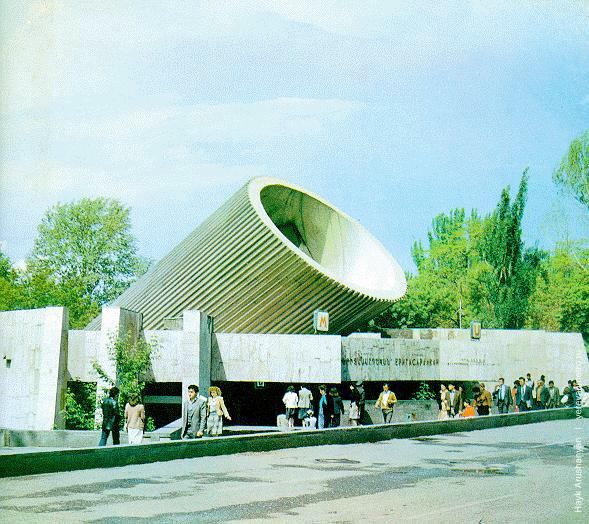
Photo credit: Yerevan Metro
Opened on March 7, 1981, “Yeritasardakan” (Youth) station was part of the very first phase of the city’s metro system. You’ll find it right in the heart of the city, at the busy intersection of Abovyan and Isahakyan streets.
Outside, the station’s walls are clad in travertine slabs, giving it that distinct Armenian touch. Like many modernist projects of the late Soviet years, Yeritasardakan was meant to break the monotony of everyday urban life. Today, it remains not just a transport hub, but also a piece of unusual buildings in Yerevan.
By the way, overall, Yerevan metro stations are also spectacular inside. This one also stands apart by its Soviet modernist design. Light gray marble lines the walls, and the floor is paved with basalt tiles. But the real highlight is the dramatic high-relief sculpture called “Youth” by artist Ruzan Kyurkchyan.
Rossiya Cinema
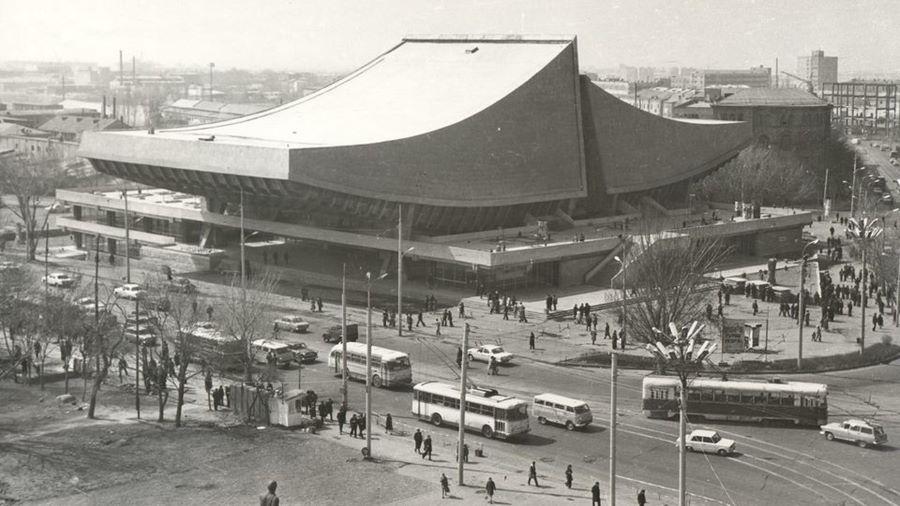
Photo credit: Visit Yerevan
This building always makes it to the lists of architectural marvels of Yerevan. We could not overlook it, either. This massive, modernist marvel opened in December 1974.
Architects poured Soviet innovation into this project, and it even won a prize in 1979. It was once a multifunctional cinema. On the upper levels there were two grand halls seating 1,600 and 1,000 people, plus a cozier 280-seat room. Below were a café, a bar, and ticket counters.
The sweeping cable-stayed roof was the first of its kind in Armenia. Unfortunately, it has not been working as a cinema for more than 30 years. It was partially turned into a commercial complex and is now also in need of renovation.
Yerevan Engineering University
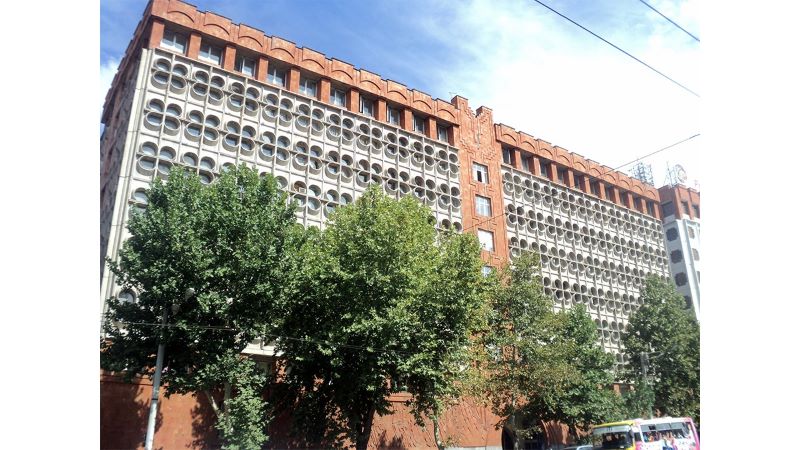
Photo credit: Visit Yerevan
The University building is located in the student quarter. Architecturally, the ensemble leans into the Soviet-era modernism, yet you can sense Armenian style.
The building has a unique shape with slabs of concrete, structured volumes, and round elements. There is also a beautiful bas-relief at the entrance.
The building wasn’t just a campus but a miniature city of engineering education, complete with dorms, faculty wings, and technical labs. At its peak in the 1980s, it educated around 25,000 students across 60 specialties.
Institute of Communication
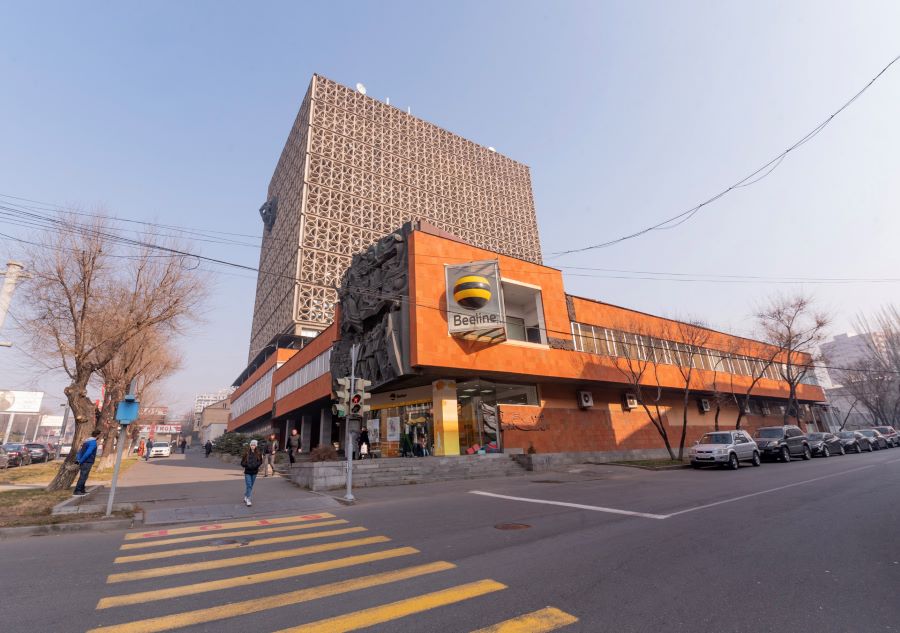
Photo credit: Urbanista
At the far end of Azatutyan Avenue stands one of Yerevan’s most striking Soviet-era giants. It’s the so-called “Communication Building.”
It was designed in 1971 by architects Armen Aghalyan and Grigori Grigoryan. The ten-story structure took seven years to complete and quickly became a symbol of Armenia’s modern telecommunications era.
This building housed the massive intercity telephone exchange, a system capable of serving nearly 10,000 subscribers. Inside, whole floors were dedicated to analog switching stations, telegraph services, and call-duration counters.
The façade features a bold concrete lattice designed to shield heat-producing equipment from the sun. Sculptor Vahe Harutyunyan added a bronze relief at the base and a globe-like ornament above. By the way, today the first floor houses the Communication Museum.