
This year, Armenian lavash once again made it to CNN’s list of the 50 best breads in the world. By the way, it’s not the first time.
Being on the list is a well-deserved spotlight for a food that carries centuries of meaning. In Armenia, bread has never been just food. It’s a symbol of warmth, always placed at the center of the table and shared with care.
To understand what bread means in Armenia, just note that when people say “let’s eat,” they actually say “let’s eat bread.” So, bread isn’t just a part of the meal; it is the meal.
While lavash often steals the show, there’s so much more to discover. In this blog, we will, of course, speak about lavash, but also other breads, the art of how they’re made, and why each one remains a living part of Armenia.
No Meal Without Lavash
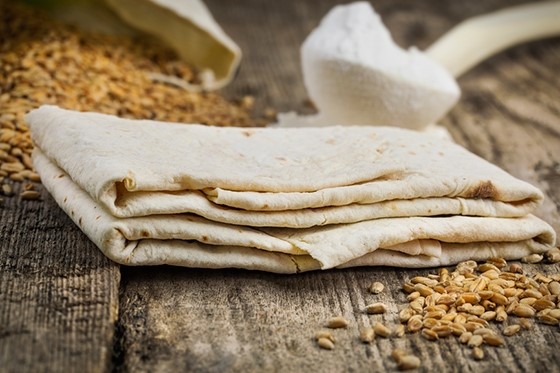
Lavash is the first and most authentic component of every Armenian meal. Thin, soft, and slightly smoky, it’s the bread that completes every table.
No matter if it’s a simple breakfast or a festive wedding table, it’s always there with cheese, vegetables, and greens. In Armenia, a meal without lavash feels unfinished, almost unthinkable.
Making lavash has been a tradition for a century. Of course, now they make it in bakeries with electric equipment as well, but it was traditionally made in a tonir. In villages, women gather around the tonir, a traditional clay oven, to roll and stretch the dough until it’s nearly transparent. The dough is then placed over a special cushion and slapped onto the hot walls of the tonir. Within seconds, the bread puffs up, browns, and is ready to be pulled out.
Most importantly, lavash is also a cultural symbol. It also holds a spot on UNESCO’s Intangible Cultural Heritage list. Families’ dry sheets of lavash to store for winter, knowing that this bread, like tradition itself, endures. During weddings, for instance, it’s laid over the shoulders of newlyweds to wish them prosperity.
How do Armenians eat lavash? They make a wrap using lavash with everything they eat. It can be meat, vegetables, cheese, greens – everything. In every sense, there truly is no meal without lavash.
Matnakash

If lavash is the soul of Armenian cuisine, matnakash is its comforting heart. It’s a golden, fragrant, and soft inside with a beautifully crisp crust.
This traditional Armenian bread is known for its signature pattern, gently traced by hand before baking. In fact, the name matnakash literally means “drawn by fingers”. It describes the way bakers press their fingertips into the dough to create the familiar oval design.
Matnakash is made from a smooth, elastic dough prepared with flour, yeast, water, sugar, salt, and oil. In earlier times, people baked it using only flour and water, relying on natural fermentation instead of yeast.
Unlike lavash, which is thin and flexible, matnakash has a fuller body. Traditionally baked in well-steamed ovens, it was once made by nearly every household. Now it’s sold in all supermarkets and local bakeries.
Jengyalov Hats (Bread with Herbs)
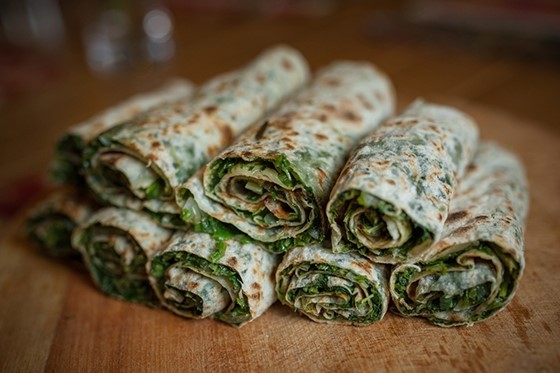
Though it may look like a stuffed flatbread, Jengyalov Hats is very much a bread. The Armenian word hats literally means “bread.”
Originating from the green, mountainous regions of Artsakh and Syunik, this dish is one of the most beloved symbols of Armenian cuisine.
The dough for Jengyalov Hats is rolled out until it’s almost transparent, just like lavash. It’s then generously filled with a mixture of finely chopped wild and garden herbs. There can be up to twenty kinds of herbs, such as spinach, sorrel, nettle, dill, coriander, parsley, and chervil. Once folded and sealed, the bread is cooked on a flat griddle until lightly browned and fragrant.
What makes this so special is that it is a great vegetarian dish. Besides, it’s a favorite at festivals, cafés, and family kitchens, especially during springtime when there are dozens of herbs collected in the mountains.
Sweet Bread or Simply Gata

If you Google “sweet Armenian bread,” you’ll likely be led to Gata. While it doesn’t look like the typical loaf or flatbread, it still counts as bread in its own rich way.
Gata is both a dessert and a tradition, found at holidays, family gatherings, and weddings.
This Armenian treat is made from a rich dough made of flour, butter, sugar, sour cream or yogurt, eggs, and filled with a sweet crumbly mix called khoritz, typically butter, flour, sugar, vanilla, and often walnuts or other nuts. Regional styles vary: in some places gata is a flat round disc with decorative dough strips, in others it’s rolled into spirals or logs.
One version even hides a coin inside; it is baked during holidays, and whoever gets that piece is supposed to receive good fortune.
It is not only baked in every day but also has a significant meaning during the wedding. Gata is a traditional gift that the family of a bride gives to the groom’s family when they first arrive at their house before going to church. This shows that it is not just a dessert but a great tradition for Armenians.
Armenian bread is far more than a meal staple, but a culture. Bread, in Armenian life, is ritual and a tradition. It’s no wonder the word for “meal” in Armenian often refers simply to bread.